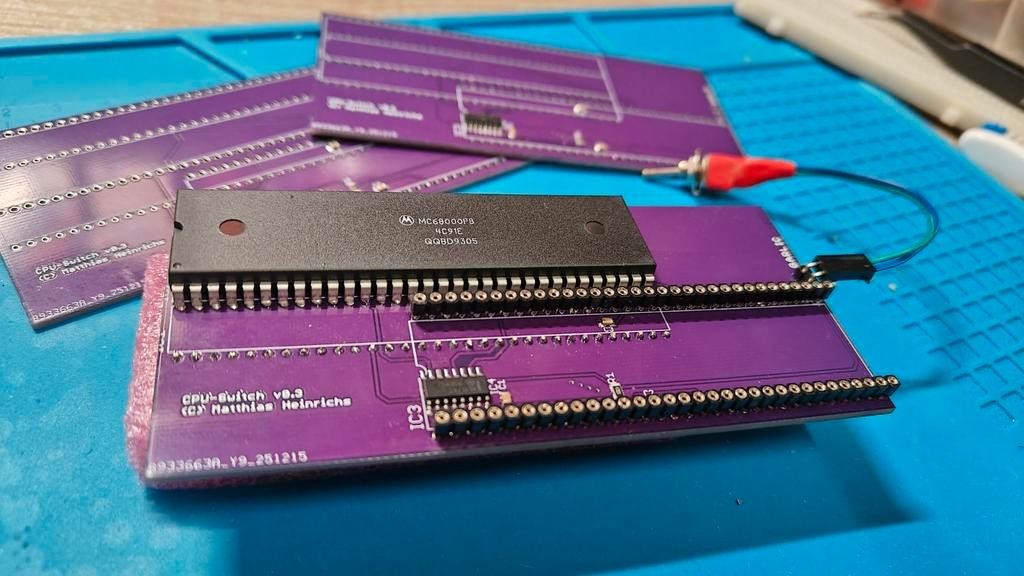
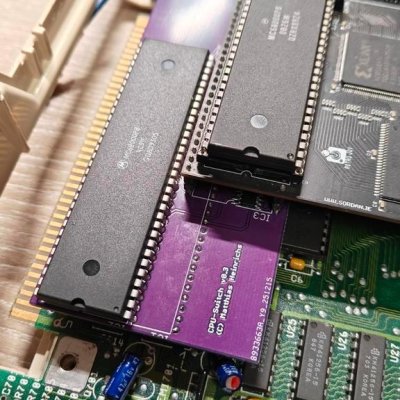
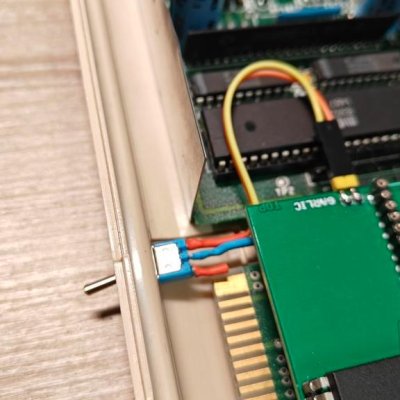
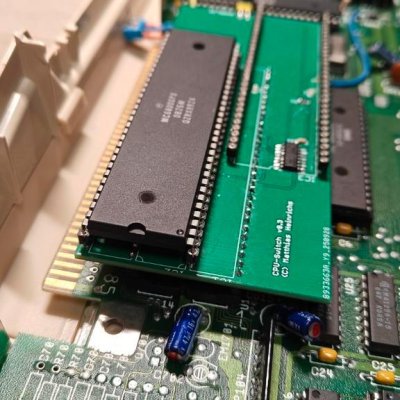
Handy switchboard for your Amiga 500 that lets you switch between the standard CPU and, for example, an accelerator, a PiStorm* or a Terrible Fire, without opening up your computer every time.
Available versions:
- €20: Bare PCB without extra parts, no switch or socket
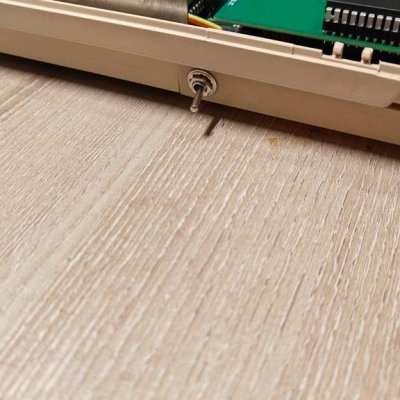
- €25: Including switch and a socket for your own second CPU
- €30: As the previous version, but with an expansion cover
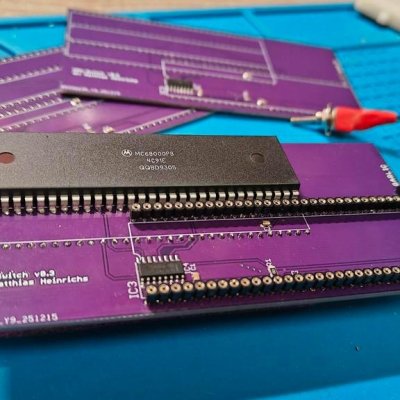
- €40: Complete version with a NOS CPU soldered directly onto the board (see the purple photo)
All versions except the €20 one have a socket for the second processor.
Small adjustments may be needed during fitting.
Condition: New
When using a PiStorm, hardware modifications are needed. We are working on a version that will hopefully work better with a PiStorm.
Collection or shipping possible, shipping at cost
More about how the Garlic works:
To understand exactly how the Garlic (and its successors such as the Garlic II) works, we need to look at how the Motorola 68000 bus works and how an accelerator card (such as the Vampire) takes it over.
The Garlic acts as a hardware bus arbiter. It does not simply switch all 64 pins of the 68000 (that would cause too much noise and delay), but manipulates specific signals to "hand over" one of the two CPUs to the Amiga.
1. Which pins are switched?
The Garlic mainly switches the signals that decide who controls the bus. The most important pins affected are:
_HALT and _RESET:
These are the most important pins for switching over. By pulling the _HALT pin of the inactive CPU low, it is forced into a "tristate" (floating) mode. The CPU stops working and releases the address and data bus.
_AS (Address Strobe):
This signal indicates that there is a valid address on the bus. The Garlic has to isolate this signal so the chipset (Paula/Agnus/Denise) only "hears" the active CPU. The address and data buses (D0-D15 and A1-A23): instead of physical mechanical switches, the Garlic uses bus switch ICs (such as the 74CBT series or similar FET switches). These ICs have an extremely low resistance ($R_{on}$ of about 5 \Omega) and almost zero propagation delay, which is essential for the timing of the Amiga bus.
2. The logic: how is it switched?
The Garlic uses a small amount of logic (often a CPLD or simple logic gates on the later revisions) to make the switch-over safe.
The "handshake":
The Garlic makes sure that one CPU is fully disconnected from the bus before the other is activated. This prevents "bus contention" (two CPUs writing to the bus at the same time), which could damage the hardware.
The CLK (clock) signalling:
The 7.14 MHz clock of the Amiga goes to both CPU sockets, but the Garlic can manipulate the clock to the Vampire or the 68000 to prevent synchronisation problems at start-up.
3. The Garlic vs. the Vampire (the "Vampire problem")
The reason the Garlic was designed specifically for the Vampire has to do with IDEO (In-System Emulation). A Vampire card "hijacks" the bus as soon as it gets power.
The Garlic solves this by:
Keeping the Vampire in a permanent reset/halt loop when the original 68000 is selected. Routing the _OVR (Override) and _INT (Interrupt) signals to the active processor.
Shipped from the Netherlands with PostNL, across Europe